Dr. Parvin Shafa | September 21, 2026
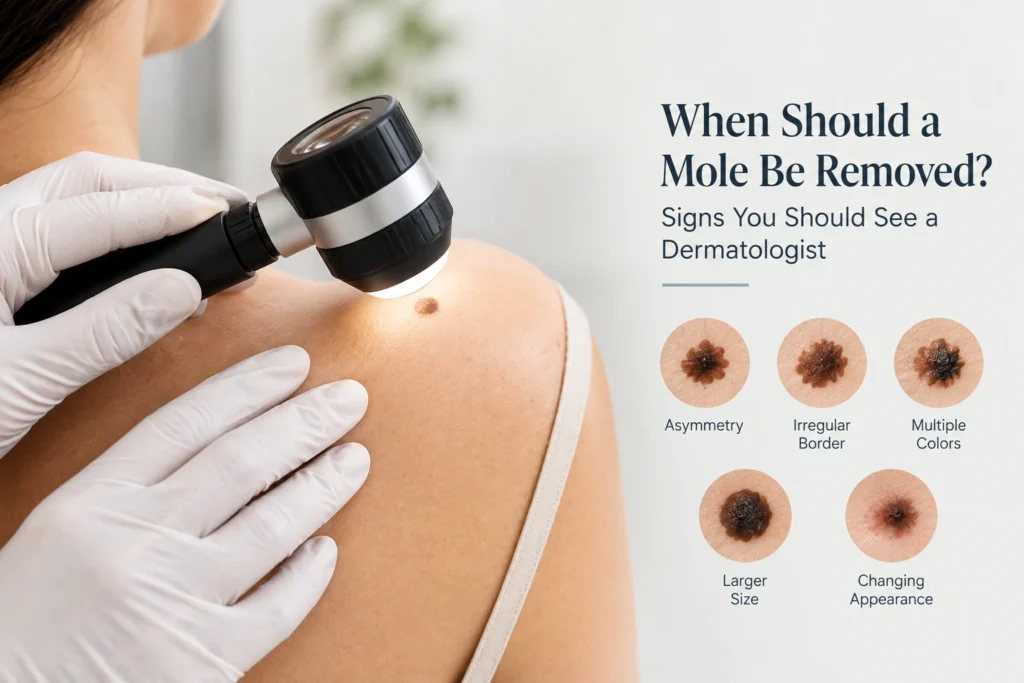
Moles are common skin growths, and most are harmless. However, a mole that changes in appearance, becomes symptomatic, or looks different from your other moles may need to be evaluated by a dermatologist.
Mole removal is not always necessary. Depending on the mole’s appearance, location, symptoms, and medical history, a dermatologist may recommend monitoring it, removing it for cosmetic or comfort reasons, or performing a biopsy to determine whether abnormal cells are present.
At OC MedDerm in Irvine, CA, Dr. Parvin Shafa provides personalized mole evaluations and removal based on the characteristics of each mole and the patient’s individual needs.
A mole, also called a nevus, is a common skin growth made up of pigment-producing cells called melanocytes.
Moles can vary in:
A typical mole may be brown, tan, black, pink, skin-colored, or another shade. Some moles remain unchanged for years, while others may naturally change over time.
Most moles do not require treatment. However, certain changes should be evaluated by a dermatologist.
No.
A mole does not automatically need to be removed simply because it is present. If a mole looks typical and is not causing any problems, a dermatologist may recommend monitoring it.
Mole removal may be considered when a mole:
A dermatologist can determine whether a mole should simply be monitored, biopsied, or removed.
One of the most useful ways to identify a potentially concerning mole is the ABCDE rule.
One half of the mole looks different from the other half.
A typical mole is often relatively symmetrical, while an asymmetrical spot deserves closer evaluation.
The border appears irregular, uneven, scalloped, or poorly defined.
An irregular border does not automatically mean a mole is cancerous, but it is one of the characteristics dermatologists look for when evaluating suspicious lesions.
The mole contains multiple colors or develops a noticeable change in color.
Concerning color changes can include combinations of brown, black, red, white, or blue.
Melanomas are often larger than 6 millimeters when diagnosed, approximately the size of a pencil eraser. However, melanoma can also be smaller, so size alone should not determine whether a mole needs evaluation.
The mole changes in:
An evolving mole is an important reason to schedule a dermatology evaluation.
The ABCDE rule is helpful, but there are other reasons to have a mole or skin spot evaluated.
See a dermatologist if a mole or spot:
A new or changing spot that looks different from the surrounding moles can be a warning sign that requires professional evaluation for skin cancer.
After examining a mole, a dermatologist can determine whether removal is appropriate. Surgical dermatology procedures may be considered when a lesion requires removal, biopsy, or further evaluation.
Removal may be recommended when a mole appears suspicious or requires further examination.
If melanoma or another skin condition is suspected, the dermatologist may perform a biopsy or remove the lesion so the tissue can be examined under a microscope.
A raised mole that repeatedly catches on clothing, jewelry, or other objects may become irritated.
In these cases, removal may be considered to reduce recurring irritation.
Some people choose to have benign moles removed because they are concerned about their appearance.
Cosmetic mole removal should still begin with an appropriate evaluation to determine what type of lesion is being treated and which removal method is suitable.
At OC MedDerm, Dr. Parvin Shafa evaluates the mole and considers factors such as its size, depth, color, location, and appearance before recommending an appropriate removal approach.
There is no single removal method that is appropriate for every mole.
The technique depends on factors such as:
Depending on the mole, options may include shave removal, punch biopsy, surgical excision, cautery, or laser treatment for selected lesions.
With surgical excision, the dermatologist removes the mole and, when appropriate, closes the area with sutures.
This approach may be considered for certain deeper, larger, or suspicious moles.
A shave technique uses a surgical blade to remove a raised or suitable superficial mole.
The appropriate technique depends on the individual lesion and whether microscopic examination is needed.
A punch biopsy removes a small, cylindrical sample of skin.
It may be used when a dermatologist needs tissue for diagnostic evaluation.
Certain small, superficial, or skin-colored lesions may be candidates for cautery or laser treatment. The appropriate approach depends on the characteristics of the lesion.
Any procedure that removes skin can potentially leave a mark or scar. The appearance of a scar depends on the removal technique, size and depth of the lesion, location, and individual healing.
Rather than promising completely scar-free removal, it is better to discuss the expected cosmetic outcome with your dermatologist before treatment.
At OC MedDerm, Dr. Parvin Shafa selects the removal technique based on the individual mole, its characteristics, and the patient’s medical and cosmetic considerations.
No.
Attempting to cut, shave, burn, or chemically remove a mole at home can result in infection, scarring, bleeding, and incomplete removal.
More importantly, removing a suspicious mole without professional evaluation could delay the diagnosis of skin cancer.
If you are concerned about a mole, professional evaluation is a safer approach.
During an evaluation, Dr. Parvin Shafa examines the mole and considers its:
Depending on the findings, she may recommend monitoring the mole, removing it, or performing a biopsy.
If removal is recommended, the treatment approach, expected healing, potential scarring, and whether the tissue should be examined can be discussed before the procedure.
Consider scheduling a dermatology evaluation if you notice a mole that is:
You do not need to wait until a mole develops every ABCDE warning sign. If a mole looks different from your other spots or is changing, it is reasonable to have it evaluated.
At OC MedDerm in Irvine, CA, Dr. Parvin Shafa provides mole evaluation and removal for patients in Irvine and throughout Orange County. The appropriate treatment depends on the characteristics of the individual lesion and the patient’s needs.
Depending on the mole, treatment may include shave removal, punch biopsy, surgical excision, cautery, or laser treatment for selected lesions. The appropriate technique is determined after evaluation.
If you are concerned about a changing mole or are considering cosmetic mole removal, you can schedule an evaluation with Dr. Parvin Shafa to discuss whether the mole should be monitored, biopsied, or removed.
No. Most moles are harmless and do not require treatment. Removal may be recommended when a mole is suspicious, bothersome, repeatedly irritated, or cosmetically concerning.
A mole that is changing, asymmetrical, irregularly bordered, multicolored, bleeding, itching, painful, or noticeably different from your other moles should be evaluated by a dermatologist.
A dermatologist can evaluate the mole’s appearance and determine whether further evaluation or biopsy is appropriate. When tissue is removed, microscopic examination can provide a diagnosis.
Most mole removal procedures involve local anesthesia to numb the treatment area. The amount of discomfort and recovery depends on the removal technique and the individual lesion.
Recovery varies depending on the removal method, location, and size of the treated area. Your dermatologist will provide specific wound-care instructions.
Some moles can recur after removal. If a previously removed mole grows back or develops new changes, it should be evaluated by a dermatologist.
Most moles are harmless and do not need to be removed. However, a mole that is new, changing, bleeding, itching, painful, or noticeably different from your other moles should be evaluated by a dermatologist.
The ABCDE rule can help you recognize some warning signs, but a professional examination is important when you have concerns about a mole.
At OC MedDerm in Irvine, Dr. Parvin Shafa provides personalized mole evaluation and removal for patients throughout Irvine and Orange County. Treatment is selected according to the characteristics of the mole and the patient’s individual needs.
Book a consultation at OC Medderm | Irvineskin Today for Medical, Surgical, and Cosmetic Dermatology in Irvine & Orange County, CA.
We are experts in Acne, Pinch blepharoplasty, Ear lobe repair, Xanthelasma repair, Syringomas removal, mole removal, Keloid removal, Body and face piecing or piercing repair or removal, lump and bumps removal, Acne scar removal, Spider vein treatment, fungal infection, Co2 resurfacing, Warts and more.
You can schedule an appointment or call us now for all the dermatology treatments. We are located at 113 Waterworks Way 100, Irvine, Orange County CA, We Are Dedicated to Providing the Best & Transparent Dermatology Care for your skin.
Call us when you want!