Dr. Parvin Shafa | July 16, 2026
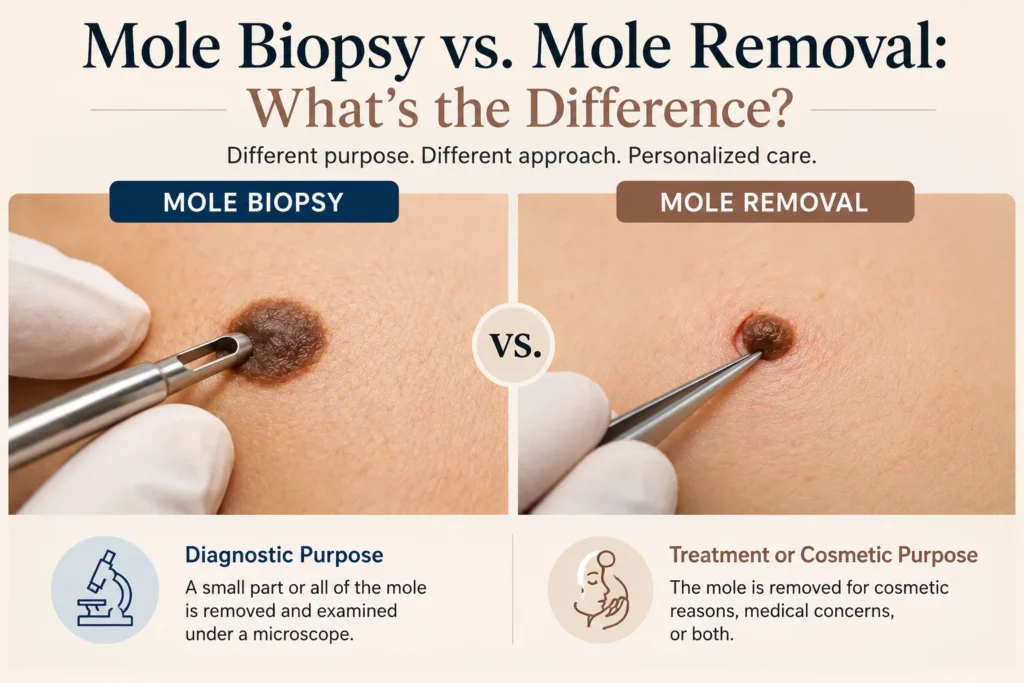
Many people use the terms mole biopsy and mole removal interchangeably, but they are not the same procedure. While both involve removing skin tissue, they serve different purposes. A mole biopsy is performed to diagnose suspicious skin lesions, whereas mole removal may be done for cosmetic reasons, medical treatment, or both.
At OC MedDerm in Irvine, CA, Dr. Parvin Shafa carefully evaluates every mole to determine whether observation, biopsy, or complete removal is the most appropriate course of action. Understanding the difference can help you make informed decisions about your skin health.
A mole biopsy is a procedure in which part or all of a suspicious mole is removed and sent to a pathology laboratory for microscopic examination.
The purpose of a biopsy is to determine whether the mole is:
A biopsy helps your dermatologist make an accurate diagnosis before recommending further treatment if necessary.
A mole biopsy may be recommended if a mole:
Early diagnosis is one of the most important factors in successfully treating skin cancer.
Mole removal refers to removing a mole either for cosmetic improvement, medical treatment, or both.
Some patients simply dislike the appearance of a mole, especially if it is located on the:
Others choose removal because the mole is frequently irritated by shaving, clothing, or jewelry.
When a mole is removed for cosmetic reasons, the primary goal is achieving the best possible cosmetic outcome while preserving healthy skin.
Although the procedure may appear similar, the reason for treatment is different.
Cosmetic removal is performed when the mole is considered benign and the patient wishes to improve appearance.
Common reasons include:
Treatment focuses on achieving an excellent cosmetic result.
Medical removal is performed when there is concern about skin cancer or when a biopsy has confirmed an abnormal diagnosis.
The treatment plan is based on:
No.
Not every cosmetically removed mole requires laboratory examination.
However, if a mole appears suspicious during your evaluation, your dermatologist may recommend sending the tissue for microscopic analysis.
The decision depends on your clinical examination and dermoscopic findings.
Several factors are considered during your consultation, including:
These findings help determine whether observation, biopsy, or removal is the most appropriate option.
The procedure is usually quick and performed in the office under local anesthesia.
Depending on the lesion, your dermatologist may perform:
A superficial portion of the lesion is removed using a specialized blade.
A circular instrument removes a small, deeper sample of skin.
The entire mole is removed along with a small margin of surrounding tissue for complete evaluation.
The most appropriate technique depends on the mole’s appearance and location.
Any skin procedure can leave a scar because the skin must heal after tissue removal.
Scar visibility depends on:
Following your dermatologist’s aftercare instructions can help optimize healing.
Sometimes.
A mole may recur if some pigment-producing cells remain after removal, particularly after certain superficial procedures.
If a previously removed mole reappears, it should be evaluated by a dermatologist to determine whether additional treatment is needed.
No.
Most common moles never become cancerous and do not require removal.
Instead, dermatologists recommend:
Removing every mole is unnecessary and is not recommended for skin cancer prevention.
Schedule an evaluation if you notice:
Early evaluation helps ensure accurate diagnosis and timely treatment.
Whether you’re concerned about a changing mole or interested in cosmetic mole removal, Dr. Parvin Shafa at OC MedDerm provides personalized care focused on both skin health and cosmetic outcomes.
Using advanced clinical evaluation and dermoscopy, each mole is carefully assessed to determine whether monitoring, biopsy, or removal is the most appropriate option. If treatment is recommended, your care plan is tailored to achieve the best possible medical and cosmetic results.
If you have a mole that has changed in appearance or simply wish to remove an unwanted mole, schedule a consultation with OC MedDerm in Irvine, CA, for an expert evaluation.
No. A mole biopsy is performed to diagnose suspicious skin lesions by examining tissue under a microscope, while mole removal may be done for cosmetic, medical, or diagnostic reasons.
Not always. Benign cosmetic moles may not require laboratory analysis, but suspicious moles are often sent for pathology to confirm the diagnosis.
No. Mole biopsies are typically performed under local anesthesia, so patients usually experience little to no pain during the procedure.
Some degree of scarring is possible after any skin procedure. The final appearance depends on the mole’s size, location, removal technique, and how your skin heals.
A dermatologist may recommend a biopsy if a mole changes in size, shape, or color, bleeds, becomes painful, or shows other warning signs of skin cancer.
Book a consultation at OC Medderm | Irvineskin Today for Medical, Surgical, and Cosmetic Dermatology in Irvine & Orange County, CA.
We are experts in Acne, Pinch blepharoplasty, Ear lobe repair, Xanthelasma repair, Syringomas removal, mole removal, Keloid removal, Body and face piecing or piercing repair or removal, lump and bumps removal, Acne scar removal, Spider vein treatment, fungal infection, Co2 resurfacing, Warts and more.
You can schedule an appointment or call us now for all the dermatology treatments. We are located at 113 Waterworks Way 100, Irvine, Orange County CA, We Are Dedicated to Providing the Best & Transparent Dermatology Care for your skin.
Call us when you want!