Dr. Parvin Shafa | April 1, 2026
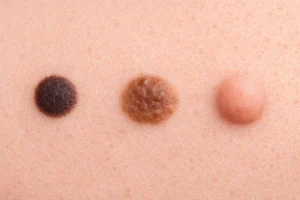
Different types of moles, including junctional, compound, and intradermal nevi, on the skin. Moles are one of the most common skin findings in both children and adults. Medically known as melanocytic nevi, moles develop when pigment-producing cells (melanocytes) grow in clusters instead of being evenly distributed throughout the skin.
While most moles are completely harmless, understanding the different types of moles can help you recognize what is normal — and when a mole should be evaluated by an experienced dermatologist Dr Parvin Shafa at OC MedDerm.
In this guide, we’ll explain:
A mole (nevus) is a collection of melanocytes — the cells responsible for producing melanin, the pigment that gives skin its color.
Most people develop moles during:
Hormonal changes, pregnancy, and sun exposure can also influence their appearance.
The average adult has 10–40 moles on their body. Most remain stable for years.
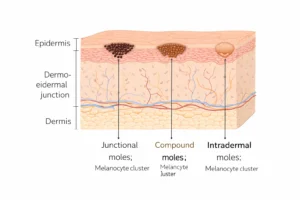
Dermatologists classify moles primarily based on where the melanocytes are located within the skin layers.
The skin has two main layers involved in mole formation:
The junction between these two layers is called the dermo-epidermal junction.
Depending on where melanocytes cluster, a mole is categorized as:
These types often represent different stages in a mole’s natural evolution.
A junctional mole forms at the junction between the epidermis and dermis.
It is considered an earlier developmental stage of a mole.
Because they sit closer to the surface of the skin, they often appear darker than other mole types.
Most junctional moles are benign. However, because they are flat and dark, they can sometimes resemble early melanoma. Any changes in:
should be evaluated.
A compound mole contains melanocytes in both:
It represents a transitional stage between junctional and intradermal moles.
Some may develop hair growth from the surface.
Compound moles are typically benign. Like all moles, they should be monitored for changes.
An intradermal mole forms when melanocytes are located entirely within the dermis, the deeper layer of the skin.
This is considered the most mature stage of mole development.
Because pigment cells are deeper in the skin, intradermal moles often appear lighter in color.
Intradermal moles are usually benign and stable. However, any rapid change, bleeding, or new symptoms should be evaluated.
Many moles follow a predictable life cycle:
Over time, some moles may even fade or disappear.
Changes that occur gradually over many years are usually normal. Sudden or irregular changes are not.
In addition to depth-based classification, moles may also be described as:
Round, evenly colored, and stable.
Larger, irregular borders, uneven color. These require closer monitoring due to increased melanoma risk.
Present at birth and vary in size.

While most moles are harmless, it’s important to watch for warning signs using the ABCDE rule:
Other concerning signs include:
If you notice any of these features, a professional skin evaluation is recommended.
If you live in Irvine, Orange County, or anywhere in Southern California, routine skin checks are especially important due to year-round sun exposure.
A dermatologist may use:
Early detection is key in identifying melanoma and other skin cancers.
Not necessarily. Raised moles (intradermal or compound) are often benign. What matters most is change in appearance.
Yes. Many moles naturally evolve from flat (junctional) to raised (compound or intradermal) over time.
No. Many benign moles are dark. Melanoma usually shows an irregular shape, uneven color, and changes over time.
No. Preventative removal of stable, benign moles is generally not necessary unless medically indicated.
Understanding the difference between junctional, compound, and intradermal nevi helps you recognize what is typical and what may require consultation.
Most moles are completely benign and remain stable for years. However, any mole that changes, looks unusual, or stands out from the others should be examined by a qualified dermatologist Dr Parvin Shafa.
If you are in Irvine or Orange County and have concerns about a mole, a professional skin consultation can provide clarity and peace of mind.
Book a consultation at OC Medderm | Irvineskin Today for Medical, Surgical, and Cosmetic Dermatology in Irvine & Orange County, CA.
We are experts in Acne, Pinch blepharoplasty, Ear lobe repair, Xanthelasma repair, Syringomas removal, mole removal, Keloid removal, Body and face piecing or piercing repair or removal, lump and bumps removal, Acne scar removal, Spider vein treatment, fungal infection, Co2 resurfacing, Warts and more.
You can schedule an appointment or call us now for all the dermatology treatments. We are located at 113 Waterworks Way 100, Irvine, Orange County CA, We Are Dedicated to Providing the Best & Transparent Dermatology Care for your skin.
Call us when you want!